
Overview
- Making collaboration ecosystems visible
- From collaborative diversity to common ground
- The CommunitySensor methodology
- The CommunitySensor lifecycle
- Strategic and tactical action directions
- How Kumu powers the collaboration maps
- Applying CommunitySensor to your situation
- Scientific foundation
Making collaboration ecosystems visible
Collaboration on complex challenges takes place in ever more interconnected networks of communities and organizations. Stakeholders need to jointly reflect upon their collaboration to improve it. This requires better shared insights into what binds participants and what their collaborative issues, priorities, and next actions are.
CommunitySensor is a methodology for participatory collaboration ecosystem mapping and sensemaking – a systematic approach to revealing, understanding, and strengthening the collaborative fabric of complex ecosystems.
From collaborative diversity to common ground
Collaborative sensemaking means getting stakeholders to engage in a participatory process that first helps them understand the diversity in their interests and perspectives. Through this understanding, they can discover how these differences enrich rather than disrupt their collaboration, ultimately achieving actionable common ground.
This process helps participants understand and strengthen their collaboration ecosystem: what are the collaborative relations and interactions, what is their context, which opportunities exist for improvement, and how to increase the support base to reach collective impact.
The CommunitySensor methodology
CommunitySensor has evolved from basic participatory community network mapping to encompass the full cycle of collaboration ecosystem mapping and sensemaking. Grounded in extensive research and years of practical experience, the methodology consists of two integrated components:
Participatory mapping
creates visual representations of the collaboration ecosystem – capturing the essence of purposes, relationships, interactions, and resources that define how stakeholders work together.
Collaborative sensemaking
brings stakeholders together to interpret these maps, discovering what the patterns mean for their shared future and identifying feasible directions for collective action.
The CommunitySensor lifecycle
The methodology involves iteratively going through four stages:
Community network mapping
Working with stakeholders to describe meaningful parts of their collaboration ecosystem, creating maps and perspectives needed for effective sensemaking. The process starts by creating a seed map outlining urgent collaboration challenges.
Community network sensemaking
Stakeholders interpreting the collaboration maps in facilitated sessions. This process results in deeper insight into issues, priorities, and concrete next actions that have broad support.
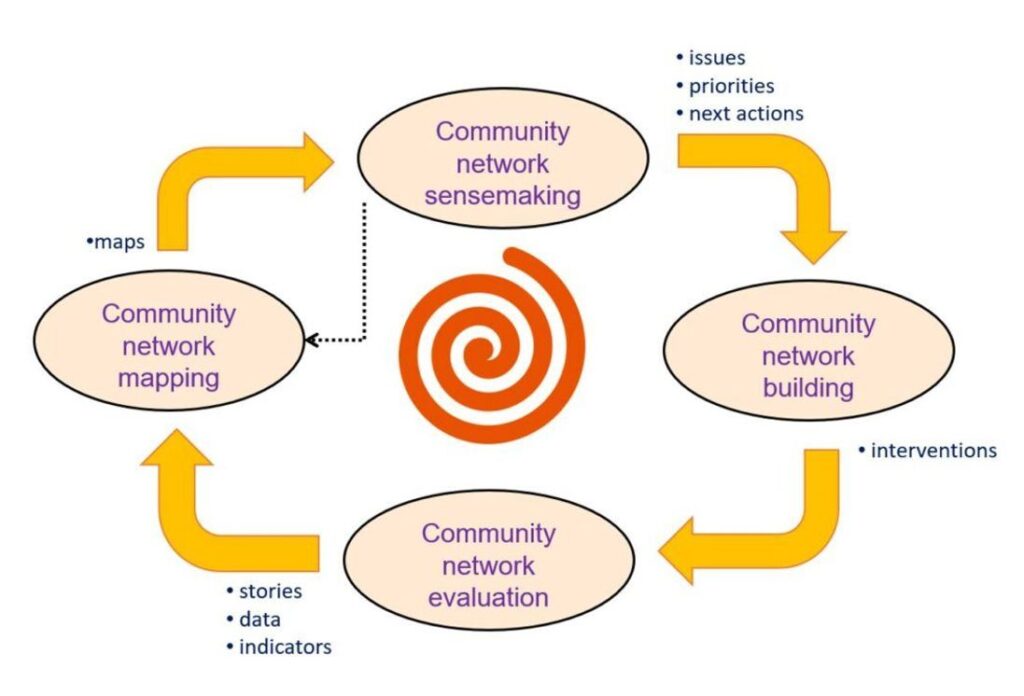
Community network evaluation
Monitoring and evaluating results of interventions, collecting insights to be put on the next version of the map.
Community network building
Based on obtained insights, stakeholders implement concrete interventions. CommunitySensor doesn’t replace existing methodologies but augments and catalyzes them through strategic use of the created knowledge maps as interactive working agendas.
Strategic and tactical action directions
CommunitySensor captures the essence of collaboration ecosystems at the strategic and tactical levels—deliberately excluding operational details that demand constant updating. Think of it as a “collaboration audit”: just as financial audits provide periodic snapshots of organizational health, CommunitySensor delivers regular assessments of collaboration vitality. Yet, the methodology extends far beyond traditional auditing, offering:
- Clear snapshots of the collaboration ecosystem’s current state and dynamics
- Multiple perspectives tailored to diverse stakeholder viewpoints
- Shared understanding of priorities and opportunities
- Feasible action directions, grounded in broad stakeholder support
- Agenda-setting knowledge to guide coordinated action
These actionable insights empower partners to align their strategies and plans, while day-to-day operations continue within their own systems and workflows.
The value lies not in real-time operational tracking, but in periodic strategic and tactical alignment—often captured in a concise, actionable agenda—that keeps complex collaborations on course.
How Kumu powers the collaboration maps
CommunitySensor leverages the online network visualization tool Kumu to create powerful, interactive maps that serve real-world purposes for collaborative action and decision-making.

This sophisticated web-based platform ensures maps remain useful and accessible to all stakeholders, supporting ongoing dialogue, coordination, and real-world impact.
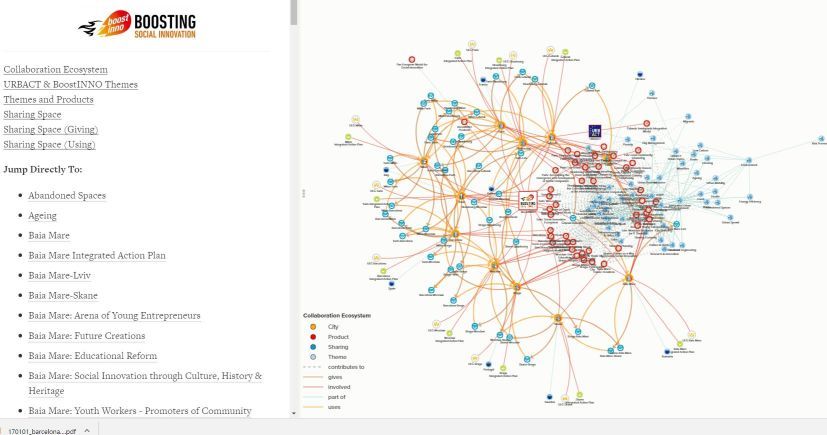
Kumu visualization features
- Interactive exploration: Click elements to see detailed descriptions, zoom to explore dense areas, and discover unexpected connections dynamically
- Multiple perspectives: Create focused views for different audiences – for instance, showing funders how their investments connect across initiatives, or helping community leaders identify potential partners
- Multimedia integration: Embed images of activities, videos of stakeholder testimonials, and key documents directly in the map
- Social network analysis: Identify which organizations serve as bridges between otherwise disconnected groups, or spot isolated initiatives that could benefit from connection
- Shareable insights: Each perspective has its own URL, allowing stakeholders to embed “their view” in websites or share in presentations
- Presentation mode: Guide audiences through the collaboration story, highlighting key patterns and opportunities step by step
Applying CommunitySensor to your situation
As each collaboration ecosystem is unique, the methodology adapts to specific needs:
- Defining scope and agenda: Establishing the collaboration ecosystem boundaries, key questions, desired outcomes, and how insights will inform collective agenda-setting
- Stakeholder engagement: Identifying who needs to participate and how to ensure legitimate representation
- Focused sensemaking: Designing sessions that address your most pressing collaboration challenges
- Implementation pathways: Connecting insights to your existing business processes, workflows and governance
Scientific foundation
The methodology builds on 25+ years of academic research in community informatics and collaboration systems. Here are some selected publications capturing the essence of the methodology:
- A. de Moor, E. Papalioura, E. Taka, D. Rapti, A. Wolff, A. Knutas, T. te Velde and I. Mulder (2023). Collaborative Sensemaking of Design-Enabled Urban Innovations: The MappingDESIGNSCAPES Case. In R. Polovina, S. Polovina, and N. Kemp (eds.), Measuring Ontologies for Value Enhancement: Aligning Computing Productivity with Human Creativity for Societal Adaptation. MOVE 2020, Communications in Computer and Information Science, vol. 1694, Springer, Cham, pp. 203-226. https://doi.org/10.1007/978-3-031-22228-3_9
- A. de Moor, E. Papalioura, E. Taka, D. Rapti, A. Wolff, A. Knutas, and T. te Velde (2023). Participatory Collaboration Mapping of Design-Enabled Urban Innovations: The MappingDESIGNSCAPES Case. In R. Polovina, S. Polovina, and N. Kemp (eds.), Measuring Ontologies for Value Enhancement: Aligning Computing Productivity with Human Creativity for Societal Adaptation. MOVE 2020, Communications in Computer and Information Science, vol. 1694, Springer, Cham, pp. 171-202. https://doi.org/10.1007/978-3-031-22228-3_8
- A. de Moor (2020). Increasing the Collective Impact of Climate Action with Participatory Community Network Mapping, Livingmaps Review, No.8
- de Moor, A. (2019). Co-Discovering Common Ground in a Collaborative Community: The BoostINNO Participatory Collaboration Mapping Case. Proceedings of C&T 2019, June 3–7, 2019, Vienna, Austria.
- de Moor, A. (2018). Common Agenda Setting through Participatory Collaboration Mapping: a Knowledge Base-Driven Approach. Proc. of the 16th CIRN Conference, Prato, Italy, 24-28 October 2018.
- de Moor, A. (2018). A Community Network Ontology for Participatory Collaboration Mapping: Towards Collective Impact, Information, 9(7): 151
- de Moor, A. (2017). CommunitySensor: Towards a Participatory Community Network Mapping Methodology. The Journal of Community Informatics, 13(2):35-58
Want to learn more? View the showcases, discover my services, or read my other publications: